Washington's Interest Rate StandoffSeptember 01, 2026 Kara Murphy, CFA, and Ryan Chang The yield on the 30-year Treasury bond touched 5.3% in mid-August, its highest in nearly two decades, putting pressure on borrowers, the housing market and the federal budget. Within days, the U.S. Treasurydoubled its buybacksof long-dated government debt. Buybacks are routine, but the market saw this one as something rarer: an attempt to push long-term rates lower, a job that usually belongs to the market and the Fed, not the Treasury. Yields briefly fell, then returned to where they began. So, what drives long-term rates, and why should investors care? Key Takeaways
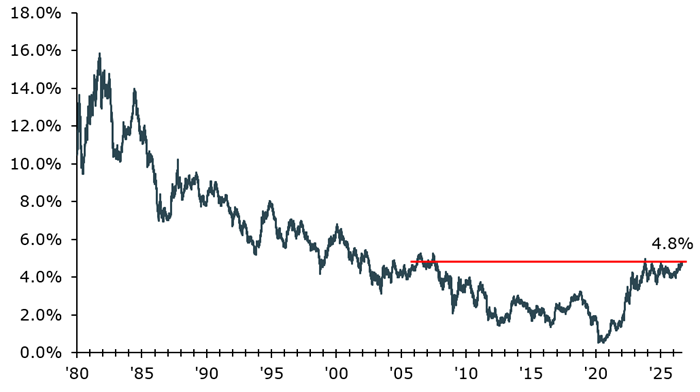
A buyback works simply: the Treasury buys its own older bonds back from investors to keep the market trading smoothly. It funds those purchases by issuing more short-term bills, swapping long-term debt for short-term debt rather than changing the overall amount of debt owed. That also separates it from the Federal Reserve’s bond-buying of years past, which created new money. On August 19, the Treasury raised the ceiling on its liquidity-support buybacks for bonds that mature in 10 to 30 years, lifting each operation from $2 billion to at least $4 billion. Ordinarily such moves are routine housekeeping. What made this one different was its timing and message: it landed just as long-term yields hit a near-two-decade high, and Secretary Bessent signaled he would buy more if yields kept climbing. Markets read it not as tidying up, but as the Treasury reaching for a lever to hold long-term rates down. The move blurred the line between financing the government and steering interest rates, which is exactly why it drew so much attention. For decades, the Treasury's approach has been "regular and predictable": borrow at the lowest cost over time and let the market set long-term rates. Bending those rates downward has historically been the Federal Reserve's role, through tools like Operation Twist in 1961 and the bond-buying that followed the 2008 crisis. The one close precedent for the Treasury itself steering long rates in 1961 was a joint effort with the Fed, and even then it nudged yields only modestly. 10-Year Treasury Yield: Elevated, but Not Historically Extreme
Past performance is not a reliable indicator of current or future results. Indexes are unmanaged and not subject to fees. Forward-looking estimates may not come to pass. Note: views are from a U.S. dollar perspective Source: Kestra Investment Management with data from FactSet, U.S. Treasury 10-Year Yield. Data as of August 28, 2026. Warsh’s AnswerDays later, the Fed offered a very different message. Speaking at the Jackson Hole symposium, Fed Chair Kevin Warsh called short-term interest rates the central bank's "predominant tool" and signaled he would not use the Fed's balance sheet to pull long-term rates down outside a genuine crisis. A sustained effort to lower long-term yields would need the Fed's cooperation, and Warsh made clear he was not offering it. If anything, the Fed is leaning the other way. Warsh reaffirmed the 2% inflation target as "firm and fixed" and left the door open to a rate increase if inflation does not cool, noting that core inflation at 3.3% remains well above target. Markets moved quickly, lifting the odds of a September rate hike from about 35% to nearly 57%. So the two arms of Washington are pulling in opposite directions. The Treasury is nudging long-term rates down, while the Fed hints short-term rates may go up. But neither one really controls the rates that matter most. The Market DecidesHere is what both sides run into: neither the Federal Reserve nor the US Treasury fully controls long-term rates. The Fed sets the federal funds rate, an overnight rate that steers the short end of the curve. The market sets the long end, the 10- and 30-year yields that matter most for mortgages, corporate debt and the government’s own borrowing costs based on inflation, growth, and the supply of bonds. That is why the buybacks faded so quickly. Yields dipped when the Treasury stepped in, then climbed back to where they started within a week. Unlike the Fed, the Treasury cannot create money. It funds its buybacks by issuing more short-term bills, which does nothing to change the forces pushing long-term rates higher. And those forces are considerable. Inflation still runs at 3.3%, above the Fed's 2% target, so long-term bonds demand extra yield to guard against it. Growth holds up and hiring stays firm, weakening the case for rate cuts. The government keeps borrowing heavily to finance large deficits, flooding the market with new supply. Bessent can lean against these pressures and Warsh can talk tough on inflation, but the market weighs all of it at once. In this tug-of-war, neither man casts the deciding vote, the market does. What We’re Watching NextFor all the back-and-forth in Washington, the long-term rate that emerges lands squarely on household budgets. The 10-year Treasury yield sets the pace for mortgages, auto loans, and other long-term borrowing. Higher rates discourage home sales and construction, and businesses feel the same squeeze as their borrowing costs rise. The government feels it too. Federal debt topped $40 trillion in August, and interest costs now trail only Social Security and Medicare among budget lines. Higher rates raise the cost of new borrowing, which adds to the debt, which raises interest costs again. That loop is exactly why the Treasury wants long-term rates lower, and exactly why the market keeps pushing back. Higher rates land hardest on the government's own budget. Total federal debt topped $40 trillion in August, and interest costs have climbed with yields. Through the first ten months of the fiscal year, net interest payments reached roughly $931 billion, up 11% from a year earlier, trailing only Social Security and Medicare among budget lines. The Congressional Budget Office projects net interest will climb from about $1.0 trillion in 2026 to roughly $2.1 trillion by 2036. Higher rates raise the cost of new borrowing, which adds to the debt, which raises interest costs again. That loop is exactly why the Treasury wants long-term rates lower, and exactly why the market keeps pushing back. The Treasury can steady the market for a day and the Fed can talk tough on inflation, but long-term rates answer to inflation, growth, and the government's borrowing needs, not to whichever official spoke last. Those forces shift slowly, which rewards patience over reaction. And there is a quieter upside in all this: after years of thin payouts, higher starting yields now offer more income from bonds than they have in much of the past decade. Invest wisely and live richly, Kara and Ryan The opinions expressed in this commentary are those of the author and may not necessarily reflect those held by Kestra Advisor Services Holdings C, Inc., d/b/a Kestra Holdings, and its subsidiaries, including, but not limited to, Kestra Advisory Services, LLC, Kestra Investment Services, LLC, Kestra Private Wealth Services, and Bluespring Wealth Partners, LLC. The material is for informational purposes only. It represents an assessment of the market environment at a specific point in time and is not intended to be a forecast of future events, or a guarantee of future results. It is not guaranteed by any entity for accuracy, does not purport to be complete and is not intended to be used as a primary basis for investment decisions. It should also not be construed as advice meeting the particular investment needs of any investor. Neither the information presented nor any opinion expressed constitutes a solicitation for the purchase or sale of any security. This material was created to provide accurate and reliable information on the subjects covered but should not be regarded as a complete analysis of these subjects. It is not intended to provide specific legal, tax or other professional advice. The services of an appropriate professional should be sought regarding your individual situation. Kestra Advisor Services Holdings C, Inc., d/b/a Kestra Holdings, and its subsidiaries, including, but not limited to, Kestra Advisory Services, LLC, Kestra Investment Services, LLC, Kestra Private Wealth Services, and Bluespring Wealth Partners, LLC, do not offer tax or legal advice. |
Markets in a Minute - Washington’s Interest Rate Standoff